

Weekly Market Commentary August 3, 2026
LPL Research highlights strong corporate earnings, AI-driven growth, and a favorable equity outlook while monitoring inflation, oil prices, and risks.

Last Edited by: LPL Research
Last Updated: August 3, 2026
Constructive on Stocks in the Second Half as AI Debate Continues
The S&P 500 settled a whirlwind July moderately lower but maintained healthy year-to-date gains. Just one month into the second half, some of our key market themes cited in LPL's Midyear Outlook 2026 wasted no time making themselves known.
Key themes emerge: Geopolitical conflicts and energy supply concerns return to the front burner, while artificial intelligence (AI) hyperscaler earnings results offer a mix of skepticism and optimism.
Our view for H2: Nonetheless, we continue to expect a supportive backdrop for stocks over the balance of 2026. Expect earnings to remain the primary driver of stock market gains, supported by healthy fundamentals across several non-tech sectors. At the same time, investors should remain mindful of risks. Here, we unpack fundamentals and discuss some keys to additional stock market gains over the second half.
Macro Backdrop Remains Challenging
As we wrote in our Midyear Outlook 2026: Policy, Buildouts, & Bottlenecks, our expectations for positive second half returns partly hinged on improvement in the macro backdrop. Well, shortly after the LPL Research team published that view, disruptions to the Strait of Hormuz intensified and the Houthis opened a new front in the battle to restore tanker flows in the Persian Gulf by attacking Saudi tankers in the Red Sea. So, after oil dipped below $70 in early July, the relief provided was short-lived as the U.S. conducted strikes on Iran over the past two weeks and oil prices shot back up over $90 a barrel. Oil has since settled in the $80s after a series of pauses, additional attacks, more threats, and reports of scheduled mediated talks.
At a high level, these developments do not change our stock market outlook for the second half. Our forecasts are slightly below consensus in part because of geopolitical uncertainty on top of the doubts surrounding the monetization of massive AI investments. As we've seen before, the Trump administration will likely find an offramp from the conflict soon, because $100 oil and $5 gasoline are sure-fire ways to lose votes in the upcoming midterm elections, now just over three months away.
Earnings Offer a Solid Foundation for Stocks in the Second Half
Stock market gains so far this year have been driven by earnings, not by higher valuations. In fact, based on the next 12 months price-to-earnings ratio (P/E), the S&P 500 is about 11% cheaper today than it was at the start of 2026 — the index P/E has fallen from 22.2 to 19.7 (source: FactSet). The debates around how much capital investment is too much and whether the hyperscalers will be able to generate acceptable returns (as we wrote about in the July 27 Weekly Market Commentary) were on full display over the last two weeks and will continue.
In the lead-off spot for hyperscaler reports was Alphabet (GOOG/L). Negative free cash flow paired with another spending hike spurred monetization worries and sent shares reeling — underpinning the market's stance that capital investment must remain elevated to meet demand but also generate returns. Case in point: the second hyperscaler to report, Microsoft (MSFT). Shares have lagged this year on spending worries but received a lift after the software giant posted its fastest cloud revenue growth in four years, cruised past free cash flow estimates, and left spending expectations unchanged. In other words, MSFT proved it can afford its massive outlays. Results from Meta (META) and Amazon (AMZN) then offered additional examples in both directions. META shares fell after reporting their lowest free cash flow since 2022, just avoiding negative territory and forcing the company to defend potential AI overinvestment. And in the other direction, AMZN's profitability and cloud unit revenue surprises were enough to offset weaker than forecast cash flows and a spending hike.
These mixed results for the AI hyperscalers highlight the key question for investors. Having the free cash flow to back up AI spending has become the biggest factor in post-earnings price action. Markets have moved from promise to execution.
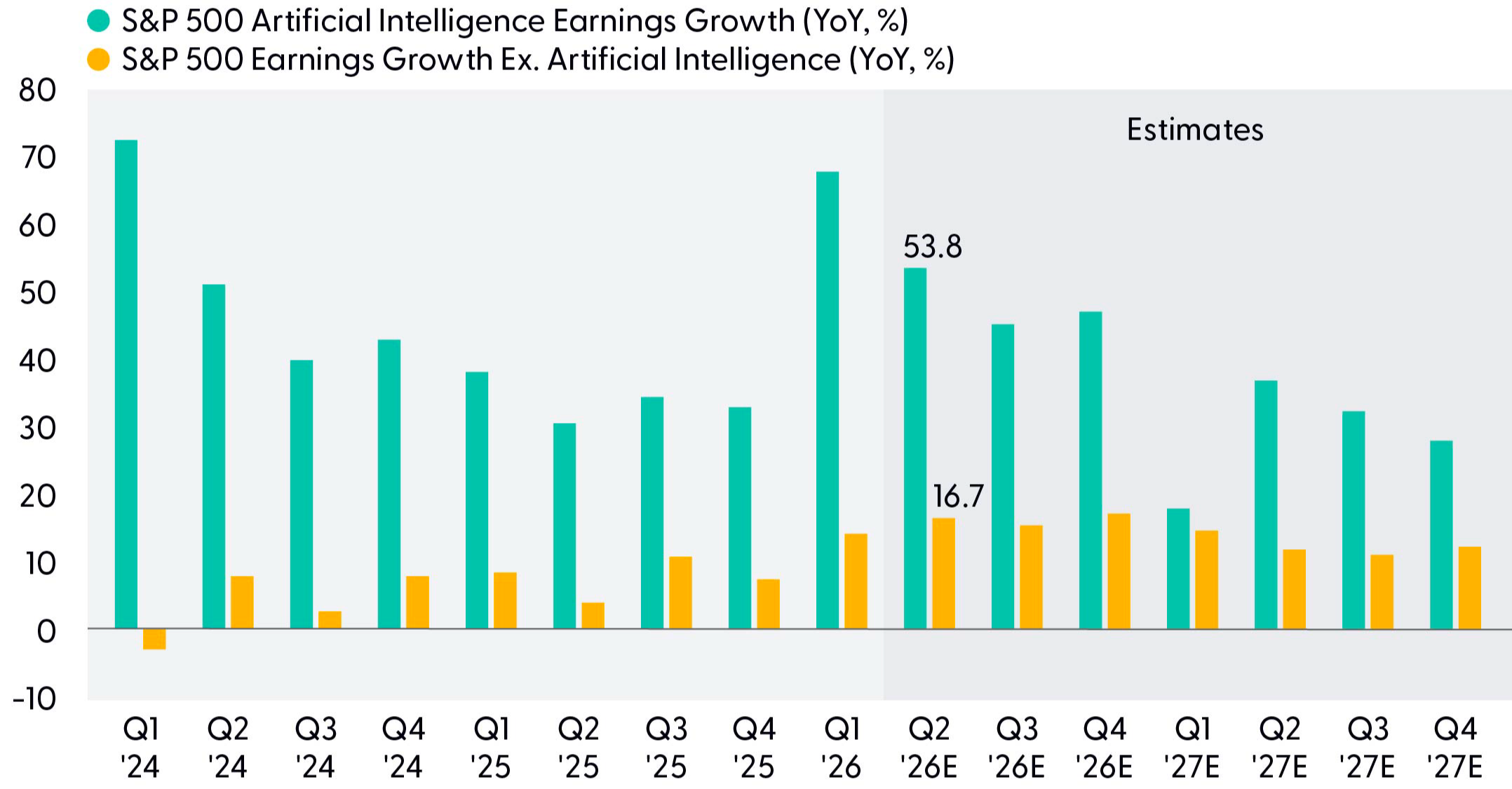
Nonetheless, despite pushback on open-ended investment, we continue to believe AI-powered earnings will persist. This earnings strength will continue to provide a solid floor for stocks in the second half, and potentially some upside as well, driven largely by AI investment. At the same time, a resilient economy will provide support for non-AI earnings, which we expect to grow double-digits through 2026 and into 2027.
Artificial Intelligence Investment is Providing a Strong Earnings Tailwind
Source: LPL Research, Bloomberg 07/30/26
Disclosures: All indexes are unmanaged and cannot be invested in directly. Past performance is no guarantee of future results. Estimates may not materialize as predicted and are subject to change.
Earnings growth so far in 2026 has been very strong at well over 20%, even if the mark-ups on private equity stakes — including holdings of SpaceX (SPCX) — are excluded. Based on the initial batch of second quarter results, with less than half of reports in the books, second quarter earnings are tracking to an impressive 26% excluding those mark-ups. An impressive 86% of S&P 500 companies have exceeded consensus earnings targets, about 10% above the long-term average. And putting the AI earnings boom aside, the average positive earnings surprises for financials and healthcare so far are +14.7% and +11.9%. Bottom line, LPL Research expects stocks to move higher in the second half on the back of strong earnings, even if the markets remain skeptical of AI investment and trading in hyperscalers remains choppy.
Valuation Discussion Requires Nuance
At a high level, stock valuations are a function of several factors that we believe are supportive of a slightly higher P/E, including: 1) above-average earnings growth; 2) below-average recession risk, bolstered by stimulus and the AI spend; 3) margin expansion opportunities by the AI adopters; and 4) the potential for an improving macro backdrop, primarily easing inflation.
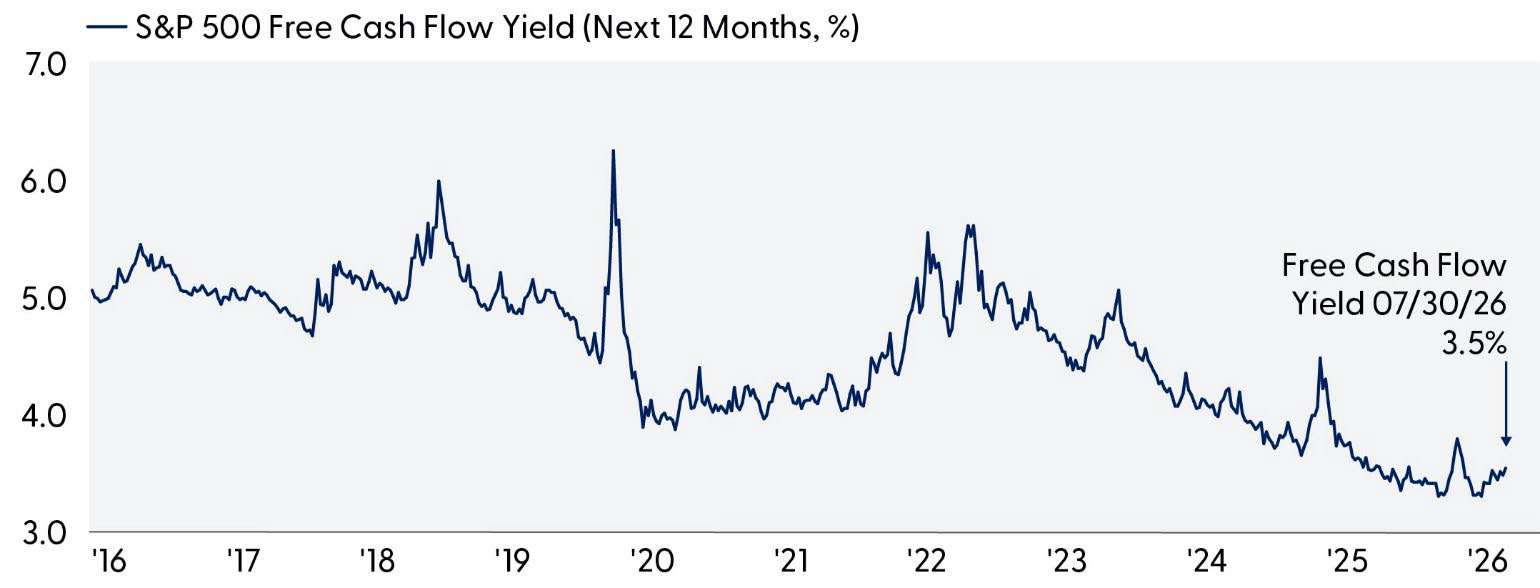
Factoring in LPL Research's views of these valuation factors, we would not argue stocks are expensive here. But it's also difficult to make the case that they are attractively valued. What we have is a market that is reasonably priced on earnings but overvalued on cash flows. The P/E on next 12-month earnings estimates has actually dipped below 20, putting the earnings yield (earnings divided by price) above 5%, which we find very reasonable. However, taking that one level deeper, on a cash flow basis, stocks are expensive — the S&P 500's free cash flow yield is 3.5%. Massive capital investments by the hyperscalers have depressed cash flows, thereby inflating cash flow-based valuations. Over the long term, cash flows matter.
Looking ahead, one of two things must happen. Either hyperscalers will support cash flows by pulling back on investments or by generating attractive returns on those investments. We'll see over the next couple of years which way this goes, but we expect more of the latter than the former, with plenty of ups and downs along the way.
Surging Hyperscaler Capital Expenditures Are Depressing Free Cash Flow Yield
Source: LPL Research, Bloomberg 07/30/26
Disclosures: All indexes are unmanaged and cannot be invested in directly. Past performance is no guarantee of future results. Estimates may not materialize as predicted and are subject to change. Free cash flow is calculated by taking operating cash flow and subtracting capital expenditures. Free cash flow yield represents free cash flow divided by price.
Risks That Could Hold This Market Back
We maintain our year-end fair value S&P 500 target range of 7,650 to 7,750, based on a P/E of 22 and our 2027 S&P 500 earnings per share forecast of $350. However, we fully recognize several risks that investors should keep in mind. The Iran conflict is not over. Shipping disruptions in the Persian Gulf are affecting more than just oil, introducing lingering inflation risks, and increasing the possibility of a Fed rate hike in September.
Beyond the Middle East, potential AI over-investment is a key risk for markets in the second half and beyond. We've seen several flavors of this risk bubble up recently, including Chinese competition in large language models (LLMs) and inference, as well as circular financing with NVIDIA's (NVDA) deal to back $250 billion of a datacenter buildout, among others.
Other risks to consider include the potential for elevated market volatility around the midterm elections and a possible flareup of China-Taiwan tensions.
Technical Analysis Perspective
From a technical perspective, the broader market has held up relatively well despite the numerous curveballs it has faced over the past two months. Escalating geopolitical tensions with Iran fueled a sharp recovery in oil prices, pushing Treasury yields higher. Trade-policy uncertainty also intensified as the administration announced several new tariffs, while threatening “substantial” tariffs on the European Union in response to recent fines targeting U.S. technology companies.
Despite this challenging macroeconomic backdrop and a historic unwind of crowded momentum trades, particularly those tied to AI, the S&P 500 remains less than 2% below its record high. Weakness in mega cap technology stocks, especially semiconductor and memory names, has limited upside progress. At the same time, a broadening rotation into other areas of the market has helped contain downside pressure.
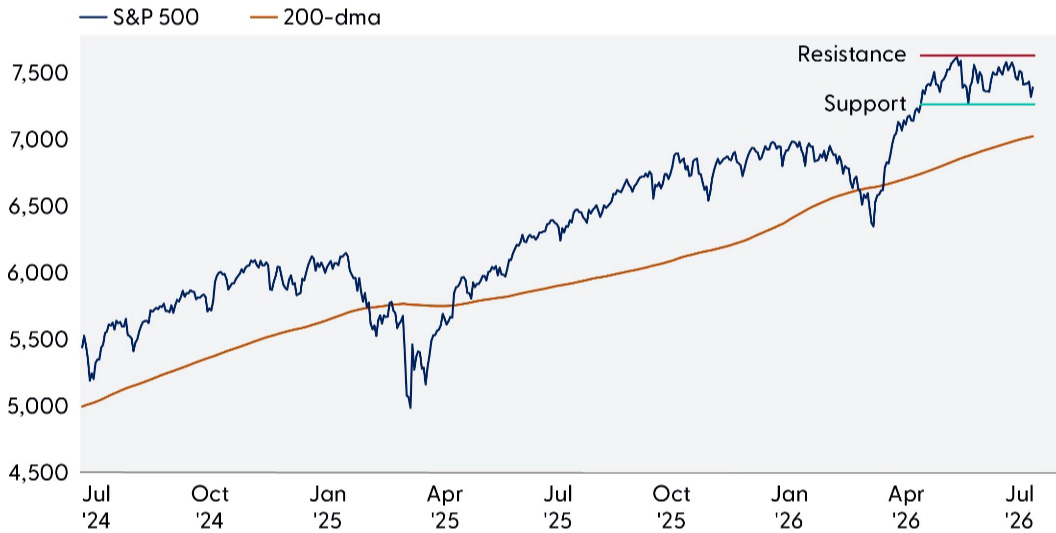
As a result, the S&P 500 remains rangebound, with resistance near the prior highs around 7,600 and support at the June lows near 7,238. A break below 7,238 would increase the risk of a deeper pullback toward the 7,000-point milestone, which also sits near the rising 200-day moving average (dma). Conversely, a breakout above 7,600 would set the stage for another leg higher. In our view, however, a sustainable breakout will require renewed participation from the heavyweight technology sector.
S&P 500 Remains Rangebound for Now
Source: LPL Research, Bloomberg 07/30/26
Disclosures: All indexes are unmanaged and cannot be invested in directly. Past performance is no guarantee of future results.
Conclusion
The combination of resilient economic growth, strong corporate earnings, and AI-driven investment continues to provide a favorable backdrop for equities. While investors are right to scrutinize elevated capital spending by hyperscalers and monitor developments in the Middle East, we believe these risks will be offset by the powerful earnings tailwind.
Valuations on earnings remain reasonable given the strong profit outlook, but expectations should remain measured. Periods of volatility tied to geopolitics, monetary policy, the AI debate, or the upcoming midterm elections are likely. Nevertheless, absent a recession, a significant policy mistake, or a material deterioration in earnings trends, we believe stocks are well positioned to deliver additional gains and reach new highs over the balance of 2026.
Asset Allocation Insights
The LPL Research Strategic and Tactical Asset Allocation Committee (STAAC) maintains its recommendation for a tactical equity overweight and fixed income underweight. While maintaining our equity and U.S. equity overweights, the Committee favors neutral style exposure. As such, this view is expressed via a defensive factor tilt given our expectation for bouts of volatility until the macro backdrop begins to improve, allowing markets to refocus on a broadly healthy fundamental landscape.
Within equity sectors, the Committee holds an overweight stance toward the energy sector due to logistical challenges surrounding normalizing global oil flows. The STAAC places value on this hedge against potential additional Mideast flare ups. The Committee also recommends an overweight to industrials, supported by strong earnings momentum, favorable technicals, and continued tailwinds from fiscal spending and AI investment.
In fixed income, the Committee maintains a neutral stance on duration relative to benchmarks, our tactical views emphasize a continued focus on quality bond sectors, caution in rate-sensitive fixed income sectors, and an ongoing allocation to diversifying strategies and alternatives.
Jeffrey Buchbinder, CFA, Chief Equity Strategist, LPL Financial
Brian Booe, Associate Analyst, Research
Important Disclosures
This material is for general information only and is not intended to provide specific advice or recommendations for any individual. There is no assurance that the views or strategies discussed are suitable for all investors or will yield positive outcomes. Investing involves risks including possible loss of principal. Any economic forecasts set forth may not develop as predicted and are subject to change.
References to markets, asset classes, and sectors are generally regarding the corresponding market index. Indexes are unmanaged statistical composites and cannot be invested into directly. Index performance is not indicative of the performance of any investment and do not reflect fees, expenses, or sales charges. All performance referenced is historical and is no guarantee of future results.
Any company names noted herein are for educational purposes only and not an indication of trading intent or a solicitation of their products or services. LPL Financial doesn't provide research on individual equities.
All information is believed to be from reliable sources; however, LPL Financial makes no representation as to its completeness or accuracy.
All investing involves risk, including possible loss of principal.
US Treasuries may be considered “safe haven” investments but do carry some degree of risk including interest rate, credit, and market risk. Bonds are subject to market and interest rate risk if sold prior to maturity. Bond values will decline as interest rates rise and bonds are subject to availability and change in price.
The Standard & Poor's 500 Index (S&P500) is a capitalization-weighted index of 500 stocks designed to measure performance of the broad domestic economy through changes in the aggregate market value of 500 stocks representing all major industries.
The PE ratio (price-to-earnings ratio) is a measure of the price paid for a share relative to the annual net income or profit earned by the firm per share. It is a financial ratio used for valuation: a higher PE ratio means that investors are paying more for each unit of net income, so the stock is more expensive compared to one with lower PE ratio.
Earnings per share (EPS) is the portion of a company's profit allocated to each outstanding share of common stock. EPS serves as an indicator of a company's profitability. Earnings per share is generally considered to be the single most important variable in determining a share's price. It is also a major component used to calculate the price-to-earnings valuation ratio.
All index data from FactSet or Bloomberg.
This research material has been prepared by LPL Financial LLC.
Not Insured by FDIC/NCUA or Any Other Government Agency | Not Bank/Credit Union Guaranteed | Not Bank/Credit Union Deposits or Obligations | May Lose Value
RES-0007122-0526 Tracking #1151346 | #1151347 (Exp. 08/27)